Showing posts with label Story of The World. Show all posts

Sunday, September 9, 2012

Middle Kingdom of Egypt


Chapter 12 in SOTW delved into the Middle Kingdom of Egypt.  The first section discusses how Egypt invades Nubia.  Egypt's new ruler, Amenemhet, a government worker -- not a pharaoh, was determined to make Egypt  bigger, so his first target was the kingdom of Nubia in Africa.  After fighting many battles, Amenemhet finally won, and the Egyptians renamed the land of Nubia to "Kush".  Over the next seven hundred years, the Nubians began to think of themselves as Egyptians, and some went on to become pharaohs in Egypt.  One Nubian woman even became the queen of Egypt through marriage.

The next section explains about how the Hyksos invade Egypt. At this point in time, Egypt was very weak and couldn't keep control of all the land.  The Hyksos were a wild and strange nomadic tribe that lived in Canaan, and they were always looking for new land to conquer. They used weapons that the Egyptians had never seen before and then took over the pharaoh's palace.  When the Hyksos became the new rulers of Egypt, it also became the end of the Middle Kingdom of Egypt.

After a hundred years, the Egyptians were able to take control back by fighting the Hyksos by making the same weapons that the Hyksos used.

Our craft project for this chapter was making our own Nubian style golden bracelet!  We cut up some toilet paper tubes and spray painted them gold.


Monday, June 18, 2012

African mask and paper beaded necklace

While perusing my new favorite blog, Relentlessy Fun, Deceptively Educational, I came across a DIY African mask.  How perfect since we just read about Ancient Africa!  I could seriously spend hours reading her blog and would do every craft/activity if I could.  At least we have one item to scratch off the list so far....

We first did a google image search to see different pictures of African masks and learn a little background behind them.  Then I used a razor blade to cut apart 2 milk jugs and cut out shapes for the eyes and a mouth.  I admit I was in a bit of a rush and quite mad at the razor blade for not cooperating, so the masks look a little choppy.  The kids didn't seem to mind though. Once the facial features were cut, I spray painted one purple for the girl and the other orange for the boy, and let them dry while the kids napped.  I then set out some random crafting items we had on hand along with a couple bottles of glue and watched as the kids went to town on their masks.


 We stapled on a strip of card stock around the back to hold the mask in place, but I'm thinking we'll replace that with a piece of stretchy elastic instead.  Maddie's mask was in place where she could see out of the eye holes right before I snapped the picture...


While the kids were napping, I cut up a bunch of used pieces of construction paper into little triangles to use for 'beads' on the paper beaded necklace.  I would have normally had Madeline do the cutting, but she is getting over a stomach bug (again!) and was actually napping for an unusually long time.  I wanted this craft to be prepared for her to get started on whenever she was ready.   She took the base of the triangle and rolled the paper around the pencil.  A little bit of glue was placed on the point and pressed firmly to keep it all in place, then she removed the bead from the pencil.  Once there were plenty of beads made, she strung them onto a piece of yarn.  Travis strung some as well, but refused to wear his necklace.

Sunday, June 17, 2012

Africa - Anansi the Spider

Who doesn't love that tricky little spider, Anansi?  He's been well liked here ever since we read Anansi and the Moss Covered Rock a few months back.  Madeline was very excited to learn Anansi the Spider is a favorite character of African storytellers. In addition to 'Anansi and Turtle' and 'Anansi and the Make-Believe Food' included in Ch. 11 of SOTW, we also read the books in the picture below.  We've actually read them a number of times so far and I have a feeling we'll be renewing these items at the library in a couple weeks.  Both the kids keep bringing them to me to read, and I've even overheard Madeline reading them to Travis at bedtime after they've been tucked in. Love those sweet moments!

Since he is so popular at the moment, we decided to use materials we had around the house to create our own tricky little Anansi.  I cut up a cardboard egg carton vertically so 2 pieces are connected together for the head and body, and the kids painted it black.  When that was dry, they glued/taped 4 black pipe cleaners (cut in half for 8 pieces) for the legs, and added some googly eyes. KPOM!


I had fully intended to fry up some plantains, as they are an African staple food, but both grocery stores I went to last week were out of stock.  I didn't realize plantains were such a hot commodity in Lexington!  Hopefully, they will be plentiful when I go to the grocery on Wed and we will be able to have a belated African-style snack.

Wednesday, June 13, 2012

Ancient China - Pictograms and Ming Bowls

Chapter 10 in SOTW covered Ancient China.  I thought Madeline would be a little bit more excited about this section since we have been eating more rice lately and also because some of her favorite food is Chinese chicken nuggets, aka sweet and sour chicken.  She liked the activities but didn't seem too concerned with the facts.

We did, however, learn that silk was first discovered in China by the empress, Lei Zu, when a silkworm dropped into her cup of tea, and we also read a story about a young boy named Chin who worked hard with his father to manage their rice fields.  He stood in cold, ankle deep water and bent down all day to tend to the rice.  The work was hard and he felt proud of himself at the end of the day.

The first activity Maddie accomplished was making her own pictogram.  Early Chinese writing used words that look like pictures.   Picto means "picture" and gram means "writing".  I found a fun Chinese pictogram worksheet here.  Madeline practiced the drawings on the worksheet and then set out to create her own.  It was suggested to paint the pictograms in black ink, but as Madeline says, "It's my pictogram painting, and I want it to be colorful."  So be it.  I think this ended up turning into just random little paintings, but she had fun with it.  After her painting was all dry, I asked her what each pictogram stood for, and I had a good giggle watching her decide what the picture should be.

Since she has been interested in playing computer games lately, I was very happy to find this pictogram game on pbskids. It kept her occupied for a little while.


The next activity, which ended up taking a ridiculous amount of time, was to make our own ming bowls.  The only reason I say it took so long was because we had to exchange more clay as the first batch was not pliable at all, even after I added a little water to it.  So back to the store I went.  I ended up just getting a small tub of Crayola air-dry clay, which had just enough clay for both kids to make a bowl.  Once we finally had usable material, go figure that it rained for a couple days, leaving us to air dry in the house instead of out in the sun.  I didn't think that would add that much time to the drying process, but it took a good 2 days even though the clay on the bowl was pretty thin. During that time, Madeline and I did a google image search to see photos of ming bowls.  When everything was finally dry and ready to go, we took it all outside to paint blue designs.


Ming bowls also make really awesome hats, in case you were wondering.  :-)

These were molded around our regular bowls covered in plastic wrap.


Madeline and Travis decided to paint the inside solid blue and decorate the outside with random designs.  Again, as Madeline says, "it's her ming bowl to decorate how she likes."  Travis got bored while painting (that's a first), and Madeline became distracted by rescuing a non-flying lightning bug.  She then had to build a habitat for the little guy in hopes of saving him.


 After getting the lightning bug's habitat in order, she finished off her ming bowl by painting pictograms on the outer part.  Travis requested a swirly, so mama painted that on his bowl.  Tomorrow, we will finally finish the bowls by adding a glaze of  glue/water with added glitter to make them fancier!


Travis' bowl
Maddie's bowl


Perhaps it would be brilliant to finish off this section with Chinese take-out for dinner tomorrow night.


Monday, June 4, 2012

Mohenjo-Daro

Last week we learned about The First Cities of India in our SOTW book.  The first section discussed river-roads, and why it was important for ancient people to live near and travel by river.  The people of India used the Indus River as a road to trade with others and settled into the Indus Valley so they could fish in the river, drink the river's water, and use it to water their fields. Along this valley were groups of independent cities (the Harappan cities) that had no great warrior trying to group all of the cities into one kingdom.

These cities were built around huge circular mounds called citadels, which were strongholds at the center of a city.  The citadels were very advanced for ancient times.  The houses were made out of mud bricks, they had toilets and drainage systems, the citadels had courtyards, wells, and even a large public bath so that everyone could stay clean and cool. 

Something unknown happened to the cities along the Indus Valley that caused people to flee.  For hundreds of years, no one knew that citadel cities were even there, as they were buried under sand and dirt.  Archeologists found ruined walls and even writings on the walls, but we have no way of reading the writing, and can't find any clues as to why people stopped living there. We'll probably never know for sure what happened.

The mysterious citadel city of  Mohenjo-Daro was built in 2600 BCE, deserted around 1500 BCE, and rediscovered in 1922.  It was located in modern-day Pakistan and had nearly 40,000 people living in it! This may have very well been the most advanced city of that time.

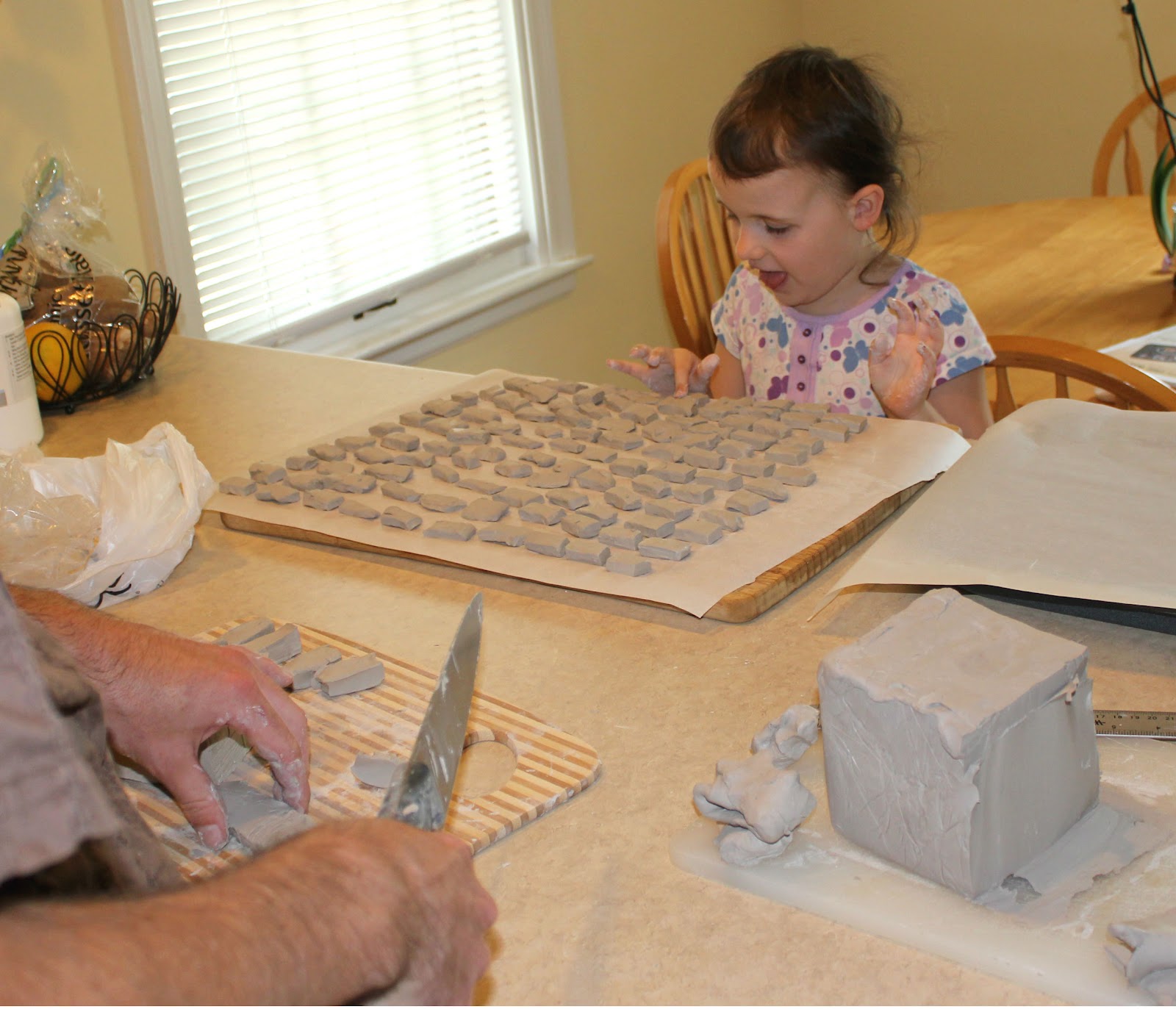
Our craft project for this section was to make a Mohenjo-Daro dwelling using air-drying clay.  I first got the red clay, which would have been perfect, except when we opened the container and cut into it, the clay was moldy.  Weird, huh?  Jake went to exchange it and said they only had regular clay left.  Anyway, Madeline started patting and spreading some of the clay out to be cut into bricks. Once it was all cut out, we placed them outside in the sun to dry.


 Meanwhile...... little buddy Travis finally fell asleep on the couch after feeling sick most of the day.

Here is Maddie being a good big sister and keeping her sick brother company while the bricks dry.  She even picked out a Spider-man coloring book for him when exchanging the clay.  Is it me, or does she look insanely big and he look insanely little in this picture?

And sadly, here is Madeline after she's come down with the same illness as Travis.  

Our bricks are dried and ready to be built into a Mojenho-Daro dwelling, but that will have to wait until everyone is feeling better.  Since Travis got sick yesterday morning and is feeling slightly better today, I'm hoping that Madeline will be feeling better by tomorrow.  On a side note.... this marks her first 'sick day' from school.  :-(

SOTW - The Jewish People

It's been a little while since I've updated what we've been up to in The Story of the World.  A few weeks back, we covered Ch. 6: The Jewish People.  We learned about the city of Ur, located in the evil Sargon's empire in Mesopotamia.  Abram and his father, Terah, were merchants who had grown rich buying and selling in Ur, thanks to Ur's handy location on the Euphrates River.  After Sargon's death, his empire fell apart, and all of the surrounding cities were fighting.  Terah worried that he would lose all of his riches if the city was overrun and burned down by the Gutians (tribes of wild people) who were invading the lands. Terah was extremely upset and went to the largest ziggurat in Ur to ask to moon-god to protect him from evil.  A ziggurat was a special pyramid, not a tomb, built with stairs on the sides so that priests could go to the top and sacrifice to the gods. Terah finally decided to move himself, Abram, and Abram's wife, Sarai, to a better place to live. 


Here is Madeline's make of a ziggurat. Travis knocked it over about 30 seconds after this picture was taken.


The story then continues that once they got settled into Haran and became successful merchants again, Terah passed away.  After his funeral, a god called out to Abram to move away from Haran and go to the land of Canaan.  Abram made a deal with God that he will obey and worship Him, and in return, God will make Abram a father of a whole new nation and give him and his entire family the land of Canaan.  God changed Abram's name to Abraham, meaning 'father of many children', and also changed Sarai's name to Sarah, which means 'princess'.  The following year, at the ripe old age of at least 90, Sarah had a baby, named Isaac. 

Then Isaac had a son named Jacob, and Jacob had 12 sons.  Each of the 12 sons had their own family, and everyone lived in Canaan.

The next section of The Jewish People focused on the story of Joseph, Jacob's favorite son.  It explained how Jacob had a beautiful and colorful coat that he gave to Joseph, and that made all of his brother's extremely jealous.  One day, while out in the field, they decided to sell their brother as a slave, and stained his beloved coat with lion's blood to show their father that Joseph was dead.  After many years of being held prisoner in Egypt, Joseph was able to decipher the Pharoah's dream about 7 fat cow and 7 ugly, thin cows to mean that there will be 7 years of plentiful crops followed by 7 years of famine.  The Pharoah instantly put Joseph in charge of collecting and storing grain during the plentiful years, making him second in command to the Pharoah himself. 

During the time of famine, Joseph's brothers walked for days from Canaan to Egypt in search of grain.  Once they arrived at the Pharoah's palace, they did not recognize Joseph as he fed them.   Finally, Joseph invited them all to a feast and told them who he was.  They thought Joseph would kill them, but instead, he invited their whole family to move to Egypt where there is plenty of food.

As you can tell from this lengthy post, we enjoyed this chapter.  We also read through a few extra books... "The Coat of Many Colors" was the favorite around here. 

Sunday, April 8, 2012

Mummies and Pyramids

I know Madeline enjoys history, but I'm starting to really enjoy it as well!  Recently we read through the chapter about Egyptian pyramids.  We've learned that they were built for the mummified pharaohs to protect the jewels and treasures that were buried with their sarcophaguses.  Sarcophagus is a really funny word to hear Travis pronounce, by the way! When the great pharaoh, Cheops, built his pyramid to eventually be buried in, he wanted it to be the biggest of all.  His is known as the Great Pyramid because it is the largest of the 35 other Egyptian pyramids.  It took Cheops 20 years to build, and was made with over 2 million stones, each weighing nearly as much as an elephant.  I can't believe it!  It seems with all the technology that we're surrounded with and dependent upon, that we would never be able to accomplish that without use of machinery in today's world.  He was even buried with a boat and other furniture in hopes that he would be able to use them in the afterworld.  Madeline built a pyramid made out of sugar cubes and came up with a good idea to build the Sphinx next to it to protect and watch over it.  Then she said, "Well that didn't take me 20 years to build!"

We also spent a good amount of time reading through a number of books on Egyptian pyramids that we've borrowed from the library.


Travis attempted a pyramid as well.  Here is a picture right after one of his sugar cube towers fell down:


Haha....Love that face!

In addition to the pyramids, we also mummified an apple slice.  The Story of the World (SOTW) Activity book suggested to mummify a whole chicken, but there was too much ick factor involved that would be sitting on my kitchen counter for weeks.  An apple slice, however, I could handle! 

 When priests prepared a mummy, they took out the organs, covered them with special spices, and stored separately from the body. The heart was taken out, prepared and wrapped in linen, and placed back into the body.  We pretended to be priests and cut out the core in our slice to represent the organs.  Madeline added the apple to a mix of baking soda, salt, and a few special spices, and sealed it up.  Ours was left undisturbed for 1 week instead of the 40 days required for a real mummy. 

At the big reveal, Madeline thought the apple smelled gross; I thought it smelled stronger than an old apple, but no different.... if that makes any sense.


Tuesday, March 20, 2012

Da Nile ain't just a river in Egypt..... completed and long post!

Last week was a really fun week.  We learned about the Nile river, how it floods every year, and why those floods are beneficial to farmers.  We also learned the Egyptian myth as to why it floods. Osirus, the great god who ruled over Egypt, was drowned by his brother Set so he could take over as king of the gods. Set tricked his brother by building a coffin to fit only him, then tossed them into the Nile.  When Isis, Osirus's wife, searched the Nile to find the coffin, she found that her husband was indeed drowned.  As she wept in grief, the Nile did too and the river ran dry.  Isis wrapped his body in linen, making him the first mummy, and he came back to life.  The Nile was overjoyed and overflowed its banks giving everyone water, and has done so every year thereafter. 

We made our own Nile to flood using a 9" x 13" aluminum pan, tinfoil, river rock, soil, and grass seed. Here the kids have added the soil to the pan.


After putting the entire bag of river rock in the tinfoil Nile River, it was time to add the grass seed.  Travis went a little overboard here.  Notice the bigger rocks?  Those are the mountains in Upper Egypt where the Nile begins, and then on the opposite side is the Nile Delta, where the river is (slightly) wider.


Now that everything is ready, it's time to flood it.  Madeline adds enough water in the river to overflow into the soil.

 Of course, the Nile wouldn't be complete without a crocodile.  Now we wait, and we'll flood it again in 1 week.  Hopefully the kids won't play in it too much!


Day 5 update:

Both kids have been super excited about checking the progress on their grass.  Here's what it looks like on day 5.  Madeline is really looking forward to flooding it again, and mentions it no less than 6 times a day.


Day 7 update:

Flood day!  Someone was very excited about today.  She couldn't believe how much the grass has grown in just 2 days, and even made a reference to the farmer's crops along the Nile. 


Madeline told me this morning that she LOVES history!  We'll watch our Nile for another week or so and see what happens.  In the meantime, we've learned about hieroglyphs and how they used to be written on stone tabs.  Madeline even got to decode her own special hieroglyph, and Travis colored in the symbols.


Day 15 update:

The grass is so tall now that it bends outward.   I think we'll paint a little pot and place the grass inside, so we can get the Nile off the kitchen counter!


Friday, March 9, 2012

Avoid the cave bears in the closet

We've been learning about the Nomads in The Story of the World this week and how/why they had to continually relocate to find food.  Once they traveled upon the Fertile Crescent, they learned to plant and harvest grains instead of roaming to different areas eating what they could find.  The Nomads were learning how to farm and staying in one location for longer. 

This also lead to a discussion on cave drawings and how people would draw pictures of animals they were hoping to hunt on the sacred cave walls.  We read, You Wouldn't Want to be a Mammoth Hunter! by John Malam, and there was a page showing animals that were edible and animals that you'd want to avoid because they'd eat you instead.  Madeline's semi-walk in closet was turned into a cave for this activity.  I taped paper to her walls and we used a candle, for the oil lamps, to see deep into the cave.  The first animal that Madeline drew was a Travis puppy.  Then she decided she needed to draw a cave bear so she knows to avoid that one.  By looking at the picture, I'm pretty sure this was a female bear. lol!


She really seems to be enjoying history so far, and even wanted one of the reading sections to be read as her bedtime story.  I like how the sections are read just like a story and aren't too long for one sitting.  I love the handy list of additional books that go along with each chapter, as we are able to get quite a few from the library. Maddie was excited to tell her daddy about the Nomads from way back when, but pretty much summed it up as, "they're dead." 

In science we learned about cells and examined an egg as a cell.  She filled in and colored an egg diagram page. Today will be making animal and plant cells using gelatin in a circle bowl (animal) and gelatin with green grapes, for the chloroplasts, in a square bowl (plants).  We read through Greg's Microscope again and looked at the pages of the animal and plant cells.  Madeline liked how the plant cells look like a brick wall.  We'll be looking at our plant under the microscope to see if it looks the same.

Here she is examining the egg with her magnifying lens to find the blastodisc, the small white spot on the yolk.

I think she burnt herself out on geography last week.  She hasn't done anything with it this week.  lol.